
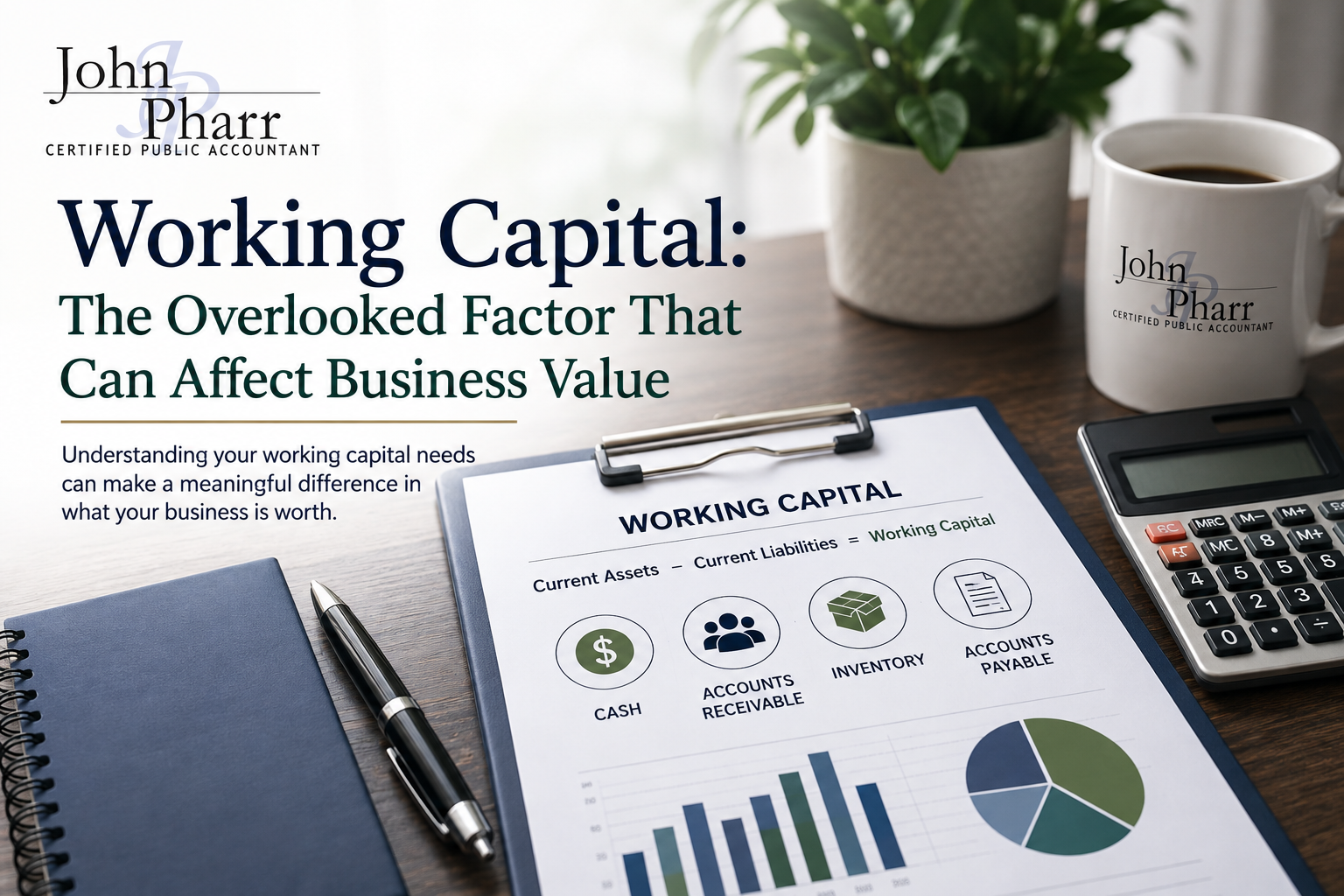
Working Capital: The Overlooked Factor That Can Affect Business Value
When business owners think about what their company is worth, they often focus on revenue, profitability, assets, and future growth. One factor that can receive less attention is working capital.
Working capital—the difference between a company’s current assets and current liabilities—helps measure the resources available to support day-to-day operations. During a business valuation, the amount of working capital a company has, and the amount it actually needs, can have a meaningful impact on the final value.
Why Working Capital Matters in a Business Valuation
When a business is valued using an income or market approach, the initial valuation generally assumes the company has an appropriate level of working capital to continue normal operations.
But the actual amount on the balance sheet may be higher or lower than what the business reasonably requires.
If a company has working capital beyond its normal operating needs, that excess may represent additional value. Depending on the facts and circumstances of the valuation, an appraiser may add excess working capital to the preliminary value of the business.
The opposite can also be true. If the business does not have enough working capital to support normal operations, additional funds may need to be invested. That shortfall can potentially reduce the company’s value.
This is why simply looking at the working capital balance is not enough. The key question is: How much working capital does this particular business actually need?
Determining Excess or Deficient Working Capital
One common measure of liquidity is the current ratio, calculated by dividing current assets by current liabilities.
For example, a 1:1 current ratio means the business has one dollar of current assets for every dollar of current liabilities. Some businesses may target a higher ratio, such as 2:1, but there is no universal ratio that is appropriate for every company.
Industry, company size, operating cycle, seasonality, customer payment patterns, inventory requirements, and other factors can all influence an appropriate working capital level.
A useful part of the analysis is comparing the company’s working capital with businesses of similar size operating in the same industry.
If a company’s current ratio is significantly higher than comparable businesses, that does not automatically mean it has excess working capital. The underlying assets and liabilities still need to be examined.
Not All Current Assets Are Equal
Suppose a company has an unusually large accounts receivable balance. At first glance, that could make its working capital appear strong.
But why are receivables so high?
If customers are simply taking longer to pay because collections are not being managed effectively, some of those receivables may be difficult to collect. Older balances might even need to be written off.
A potential buyer will generally be interested not only in the amount reported on the balance sheet, but also in how readily those current assets can be converted into cash.
Higher-than-normal working capital consisting of assets that can realistically be converted to cash may provide stronger evidence that the company has excess working capital.
Looking at the Company’s Operating Cycle
Comparing a company with industry averages is useful, but every business operates differently.
Another approach is to examine the company’s operating cycle—the amount of time and resources required to move through its normal business activities.
The concept is associated with the Bardahl Manufacturing Corp. v. Commissioner case and is often referred to as the Bardahl formula.
Rather than relying only on a general current ratio or working capital as a percentage of assets, this approach considers the company’s operating cycle and estimates the amount of working capital necessary to support that cycle.
This can be particularly important for businesses with significant seasonal fluctuations.
For example, a seasonal company may require substantially more working capital during its busiest months than an annual average would suggest. In those circumstances, evaluating peak working capital requirements may provide a more meaningful picture than relying solely on a 12-month average.
How Working Capital Can Affect the Final Business Value
Once the company’s normal working capital requirements have been analyzed, those requirements can be compared with the working capital actually available as of the valuation date.
If the company holds more working capital than reasonably necessary to operate the business, the excess may be added to the preliminary value determined under the applicable valuation approach.
If the company has less than it needs, the shortfall may reduce the preliminary value because a buyer could need to contribute additional capital to operate the business normally.
The impact can be significant, particularly when a company has accumulated substantial cash, receivables, inventory, or other current assets.
The Bottom Line
Working capital may not receive as much attention as revenue, earnings, or growth when business owners think about valuation, but overlooking it can result in an incomplete picture of what a company is worth.
Too much working capital may indicate value beyond what is required for normal operations. Too little may signal that additional capital will be necessary. Determining the appropriate amount requires more than applying a standard ratio—it requires understanding the company’s industry, operating cycle, assets, liabilities, seasonality, and individual circumstances.
Considering a business valuation or preparing for a future sale or transition? The Pharr CPA Team can help you better understand the financial and tax considerations that may affect the value of your business.
Contact our office at 850-435-8844 to discuss your situation.
This article is provided for general informational purposes only and is not intended as tax, accounting, legal, investment, or business valuation advice. Individual circumstances vary. Consult the appropriate professional advisers regarding your specific situation.


About Post Author